Happy Friday!
I hope your upcoming weekend is off to a great start.
Have you had a chance to read part 2 of Hunter’s birth story? It’s a lovely follow-up and worth a look.
Today Hunter and I are visiting a friend who had her baby on Tuesday. Her daughter is about eight days younger than Hunter but was nine pounds at birth, so she’s already much bigger. Neither baby is old enough to really notice the other yet, but it should be fun to see them together.
Today’s guest post is from Kristen, who shares excellent photography tips—her photos always look fantastic and remind me how much I want a DSLR!
Hi all! I’m Kristen and I blog at Swanky Dietitian. Heather invited me to write a guest post and I gladly accepted. Heather’s blog was one of the first I followed when I started mine a little over two years ago.
Although I’m a dietitian and could easily write about food, I wanted to share another passion of mine: photography.
Since I got my DSLR last Christmas, I’ve fallen in love with photography. I recently attended the Capturing True Emotion workshop and picked up several practical tips. I usually shoot in manual mode because it lets me adjust every setting.
What camera do I use?
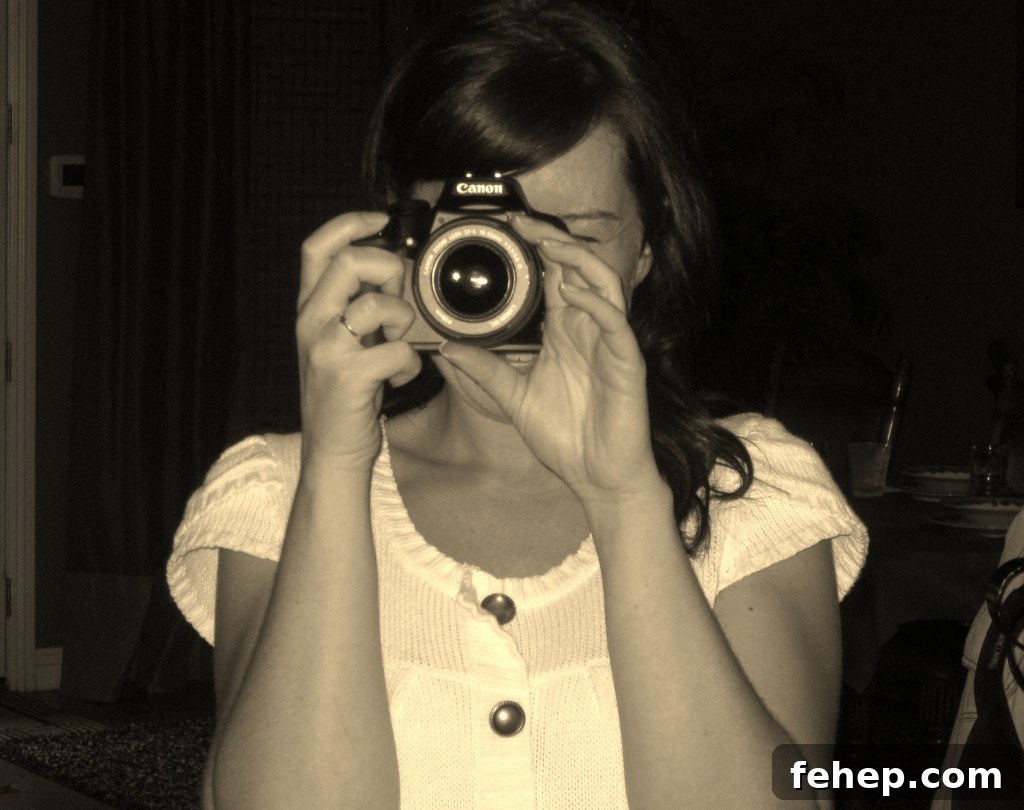
I use a Canon Rebel EOS with the EF-S 18-55mm f/3.5-5.6 IS lens. It’s a great starter camera that produces lovely results.
I also use an EF 50mm f/1.8 lens, which is fantastic for close-ups—perfect for food photography and portraits.
Basic elements of photography
- ISO
- Aperture
- Shutter speed
Familiarize yourself with where these three settings are on your camera; they’re the foundation of exposure and creative control.
ISO
ISO determines how sensitive the camera’s sensor is to light. Think of it like your pupils: they widen in low light and narrow in bright light.
Low ISO (ISO 100) makes the sensor less sensitive to light. Use low ISO in bright conditions—especially outdoors—to achieve high image quality.
This next photo was taken outdoors in bright light using a low ISO.
High ISO (ISO 800 or higher) makes the sensor more sensitive to light and helps in darker settings, like dim restaurants, but usually produces lower image quality (more noise).
Aperture
Aperture controls how much light enters the lens and affects depth of field—the area that appears in focus.
Large apertures (small f-stop numbers like f/2.8) let in more light and create a shallow depth of field, which is great for close-ups and subject separation. Small apertures (large f-stop numbers like f/16) let in less light and give a greater depth of field, making more of the scene appear in focus.
Use a wide aperture for blurred backgrounds and close-up detail; use a narrow aperture when you want more of the scene sharp.
Shutter speed
Shutter speed controls how long the camera’s shutter stays open and thus affects exposure and motion rendering.
A simple rule: your shutter speed should be at least the focal length of your lens (or slightly higher) to avoid camera shake. For example, use 1/55 or faster when shooting with a 50mm lens.
Fast shutter speeds (e.g., 1/500) freeze motion. Slow shutter speeds (e.g., 1/30 or slower) introduce motion blur, which can be used creatively.
In the photo below, a slow shutter speed was used to blur the moving person.
Mastering ISO, aperture, and shutter speed opens endless possibilities. My best advice is to get out and shoot—experiment with settings and lighting. Lighting is the most important element in photography, so pay attention to it and learn how it affects your images.
Stop by my blog and say hello. I’d love to hear your photography tips!
Kristen is a Registered Dietitian pursuing her Master’s degree. She lives in Las Vegas and enjoys traveling, cooking, and yoga. You can find her at Swanky Dietitian.