Have you ever pulled out a favorite recipe and wished it could be made in a slow cooker? Or perhaps you have a trusted crock pot dish and want to bake it in the oven instead? Converting between slow cooker and oven cooking is a practical skill that can rescue last-minute meal plans, make better use of kitchen equipment, and help you adapt recipes to the tools you have on hand.
This simple conversion guide will help you determine how to adjust times and temperatures when switching from a crock pot to the oven, or vice versa. It explains the basic assumptions, offers an easy-to-follow method for conversions, and gives practical tips so your recipes remain flavorful and safe to eat.
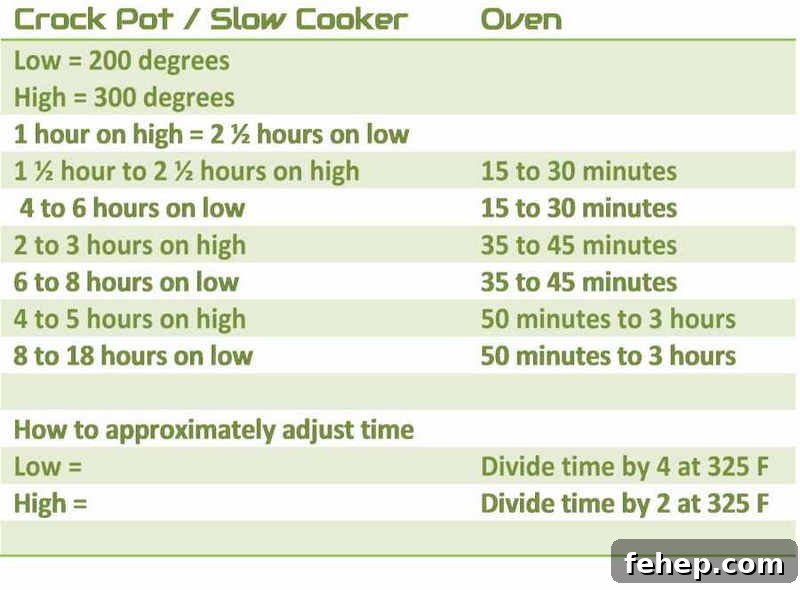
First, keep in mind that not all slow cookers and crock pots run exactly the same. Manufacturer models vary and the actual temperatures for “low” and “high” settings can differ slightly. If you still have the owner’s manual for your appliance, check it for listed temperatures for the low and high settings. As a general guideline, many slow cookers approximate about 200°F on low and roughly 300°F on high, though some units will be a little warmer or cooler.
With those typical temperatures in mind, the most straightforward conversion is to set the oven to the same temperature you expect the slow cooker to use and bake for the same amount of time the recipe calls for. That approach keeps the cooking environment similar and often yields reliable results when the recipe is broadly forgiving (for example, stews or casseroles that tolerate slow, even heating).
If you’d rather shorten the overall cooking time by using a higher oven temperature, a simple math trick helps you estimate an appropriate adjustment. The calculation is basic division: for a recipe that calls for the slow cooker’s low setting, divide the stated slow-cooker time by four and bake at about 325°F in the oven. For a recipe that calls for the slow cooker’s high setting, divide the slow-cooker time by two and bake at 325°F. These conversions are approximate but useful starting points for many dishes.
For example, a recipe that simmers in a crock pot on low for eight hours would convert to approximately two hours in a 325°F oven by the divide-by-four rule. Likewise, a crock-pot high setting recipe that cooks for four hours would translate to roughly two hours in the oven at 325°F using the divide-by-two rule. Always check for doneness and adjust as needed for your oven and the specific dish.
When converting in the opposite direction—going from an oven recipe to a slow cooker—use the reverse math. Multiply the oven baking time by two to approximate a crock pot on high, or multiply by four to estimate low. This helps you determine how long to let the slow cooker run so ingredients reach a safe temperature and become tender without overcooking.
Beyond the time-and-temperature math, there are practical considerations to keep in mind. A slow cooker is a moist cooking environment with a tightly fitted lid that traps steam and minimizes evaporation. When you move a recipe to the oven, even at a lower temperature, you may see more evaporation unless the dish is covered. To maintain moisture, cover the baking vessel with a lid or foil, or use a tightly fitted oven-safe pan. Conversely, recipes that rely on oven browning or crisping may not achieve the same texture in a covered slow cooker; in those cases, you can finish the dish uncovered under the broiler or give it a brief high-temperature oven time to crisp surfaces.
Also consider ingredient order and liquid amounts. Slow-cooker recipes often require less added liquid because little evaporates during the long cook. If you move a slow-cooker dish to the oven, you may need to increase liquid slightly to prevent drying, unless you plan to cover the dish well. Likewise, delicate ingredients like cream or dairy added early in a long slow-cooker cycle may behave differently in a higher-temperature oven; sometimes they’re best added near the end of the cook.
I used this same approach when I made a big batch of Irish Parliament Bean Soup and ended up with enough soup to fill two large crock pots. The conversion method helped me scale the timing and keep the soup rich and well-cooked without overcooking the beans or losing too much liquid.
Have you converted any recipes successfully between oven and slow cooker? Sharing your experiences and tweaks can help others adapt dishes with confidence. Small adjustments in time, temperature, cover, and liquid usually get you to a delicious result.
Noel
Interested in more recipes or tips featured here? Check the books and resources you already own or consult recipe collections you trust to find tested methods for converting between oven and slow cooker techniques.